 |
Turkish |
 |
|
Terms and References:
|
|
Terminology for the defensive structures on Ile de la Passe is in the process of being standardized according to
terms that are clearly defined on the excellent web site of the Palmerston Forts Society (PFS)
and particularly in the section entitled "A Glossary of Victorian Military Terms" at:
http://users.argonet.co.uk/users/dmoore/gloss.htm
|
|
Periodization also follows that established in 2002, the earliest being the French Period up to 1810, followed by the early British, the British construction of the Observation Tower, Central Building and the North-West Building in the late Nineteenth or early Twentieth Century and the World War II Installations. Our insights have been amplified by the assiduous archival research that has been carried out by Dr Marina Carter and we are extremely grateful to her for so generously sharing with us the fruits of her labors. Dr Carter's as yet unpublished results have influenced our own conclusions in important ways. |
|
The Condition of the Islet and its Monuments at the Start of the 2003 Season
|
|
Since the end of the last, 2002,
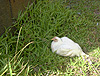
seasona considerable amount of rubbish had accumulated on Ile de la Passe,
much of it the result of camping on the islet during the Christmas and New Year period.
Good intentioned attempts had been made to pile rubbish up and some of it, although by no means all,
was in sacks and bags. Generallythe islet was not in such a foul state as at the start of the first campaign in 2002.
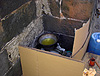
There had been some further damage to standing structures as a result of cooking fires being lit against walls and inside standing structures. While the extent of this damage is not in itself disastrous, the accumulative effect is considerable and, if not halted, will result in the loss of graffiti, some of which have considerable historical importance for Mauritius. Besides this loss, fire damaged wall faces will be both difficult and expensive to repair. On Wednesday February 19 the islet was left free of recent rubbish. |
 |
 |
|||||
| 03jv1914 | 03jv1913 |
|
Overview of Results
|
|||||||||
|
1. Recording of standing architectural monuments
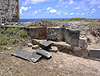
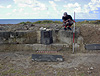
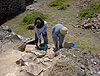
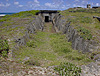
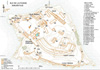
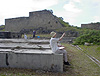
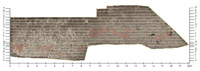
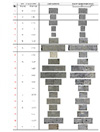
Digital photographs and measured sketches for photo-rectification and architectural studies were made of the North Wall of Upper Battery as well as of the Upper Battery Parapet Wall, World War II Shell Cabins and the features between the Shell Cabins and the Observation Tower. Photographs, measured drawings and written descriptions of the Underground Generator Halls were also made. 2. Mapping ramparts The NHT commissioned a highly accurate map that was made by a Mauritian firm of professional surveyors. Our new discoveries and insights have been added to this excellent map, which will also provide an excellent basefrom which to draw up management plans for walkways and footpaths and the positioning of new facilities. 3. Uncovering and cleaning gun emplacements and other remains. As far as the 2003 season of fieldwork is concerned this highly successful aspect of the scheme of research has been completed. Plans and sections were drawn to scale while measured drawings made of elevations for photo-rectification. In addition, extensive notes were made. 4. Limited exposure of remains through the clearance of vegetation and rubble. This aspect of the work consumed the greater part of the available time and energy. Following consultation with Dr Ashok Khadun, Botanist and Island Restoration Manager with the Mauritian Wildlife Foundation, it was possible to cut back and remove any vegetation that was obscuring walling, graffiti or other features in the full confidence that no rare endemic species would be harmed. Indeed, it was rewarding to be able to begin the process of eradicating unwanted exotic species from the islet, a task that we would like to continue more methodically in future seasons. A digital illustrated list of plant species was made and is available on request. One of the principle objectives in the 2003 field season was to clean away vegetation fallen debris, accumulated rubbish and wind blown sand so as to uncover sections of the inner face of the Upper Battery Parapet Wall and Gun Emplacements, parts of the Central Platform and the sides of the large Ditch on the north-western side. Care had to be taken in removing the vegetation because pulling plants out of walling by their roots tended to dislodge masonry. In general, therefore, growth was cut back with hand clippers (sécateurs) or by a grass cutting machine rather than being uprooted. Modern broken glass, of which there are large quantities, potential hazard to hand cutting. The grass cutting machine was also used to trim the grass around the base of the monuments that had been cleaned last year. Thisprocedure not only enhances the look of the islet but it also discourages visitors from throwing rubbish, suchas tins and bottles, into the long grass. 5. Examination of the enigmatic "ditch" and its associated features Vegetation was cut back along both sides of the ditch so as to expose fully all of the graffiti that were hidden from view. In addition the channels and their stepped terminations were partially cleaned. It was decided to strike a balance between the total removal of rather attractive vegetation and the more usual archaeological practice of total cleaning for the sake of clear and complete photographs. Yet another factor in the decision to leave most of the vegetation along the top eastern side of this feature was the barrier that it provided against accidentally stumbling into the Ditch. A full photographic record was made of the graffiti and the measurements recorded by scrambling through bushes and undergrowth in 2002 were checked and found to be correct. 6. Recording graffiti Systematic recording of graffiti began with the tall North Wall of the Upper Battery and the external walls of the Storehouse. As related above, the graffiti in the Ditch were also photographed and studied. There are a great many more to record and collate, not least in and around the Powder House. No pre-British examples have been found and very few (if any) appear to have been cut earlier than the late 1850s. Further, to date no graffiti have been discovered that might be associated with the construction of the Observation Tower and its companion structures some time between the very end of the Nineteenth Century and the First World War. One major concern associated with recording graffiti is the time needed after work in the field to process digital images and to transcribe each individual graffiti. 7. Undertaking limited emergency conservation using lime mortars to replace key blocks of stonework Good progress was made at the northern end of the Upper Battery. It is essential to understand two crucial concerns: (i) Everything that has been done is reversible. In this respect it should however be realized that the restoration of standing structures, such as the Observation Tower and the Store House, will not and cannot be reversible because of the materials that were used in World War II and also because there are structural issues that will have to be addressed. The pre- World War II Upper Battery does not, however, have problems of the same order (although the World War II Shell Cabins will need some attention in the near future). (ii) The conservation undertaken in 2003 was experimental in nature. To a very large extent the local artisanswho were employed guided decisions on the day-to-day mixtures of lime mortar with red earth and with sand with which they themselves proved to be greatly experienced. It was also learnt that these skilled men could measure and saw blocks of coral to fit precisely where they might be required. On the other hand, first attempts failed to attain the high standard expected with the result that some of the early trials had to be redone. With close supervision and the growing realization that qualityrather than speed are of the essence in this particular type of work, a great team can be speedily built. In general Emplacements 1 and 2 have been partially restored and consolidated as well as the intervening and adjacent stretches of the parapet wall. Fallen stones have been set back in their original positions in the very few cases where it was obvious from whence they had fallen. Otherwise stones were selected and set in a way that mimicked as nearly as possible the original character of the wall. At the Emplacements new stones had to be cut for the angles, and indeed occasionally for elsewhere. This was done with a simple wood saw. Newly cut stone is, however, gleaming white. Experiments with ways of artificially ageing the newly cut surfaces are in hand. The length of time taken by the natural processes that make the cut coral stone grey is not known but it is of interest that when new the battery walls, and the stone buildings, would have been gleaming white. |
 |
 |
 |
 |
 |
||
| 03jv0605 | 03jv3510 | 03jv1618 | 03jv2908 | Rectified digital photo |
 |
 |
 |
 |
||
| Site map | 03jv2002 | Graffiti | Excel table |
Turkish |